Color by / Stacking
Color options
Section titled “Color options”Color sets a facet across the given data set to create individual series. Color options also include stacking controls for the visualization.
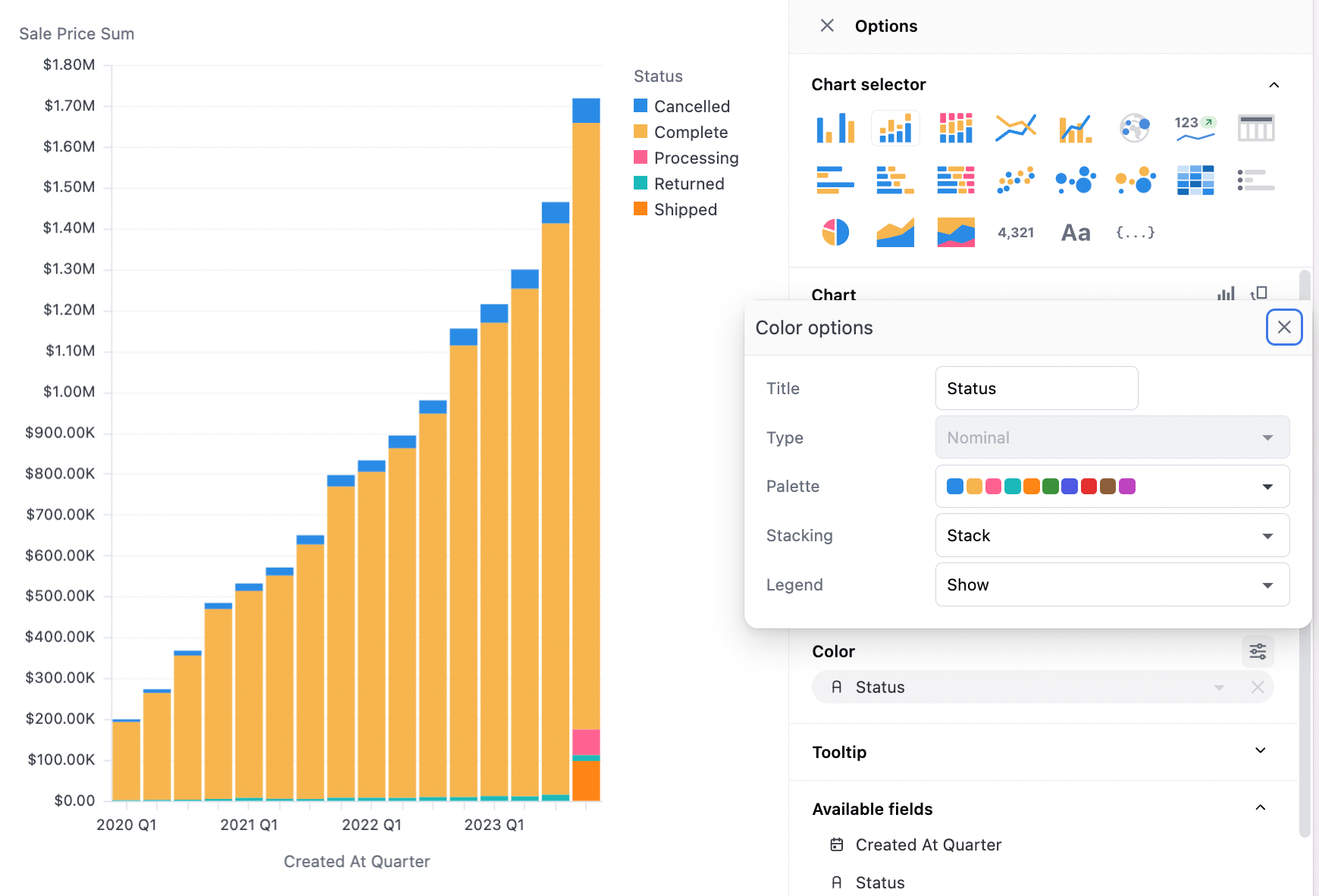
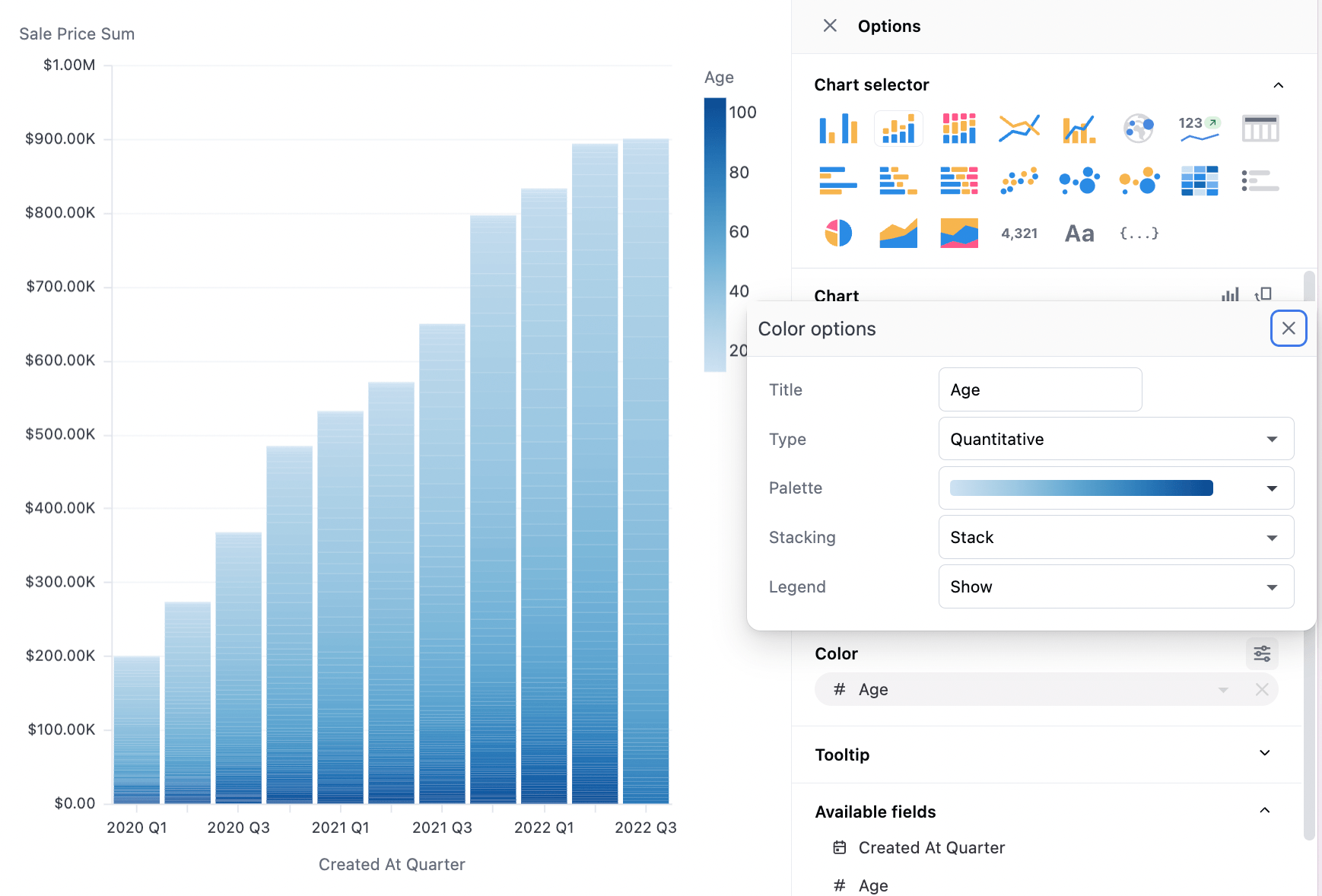
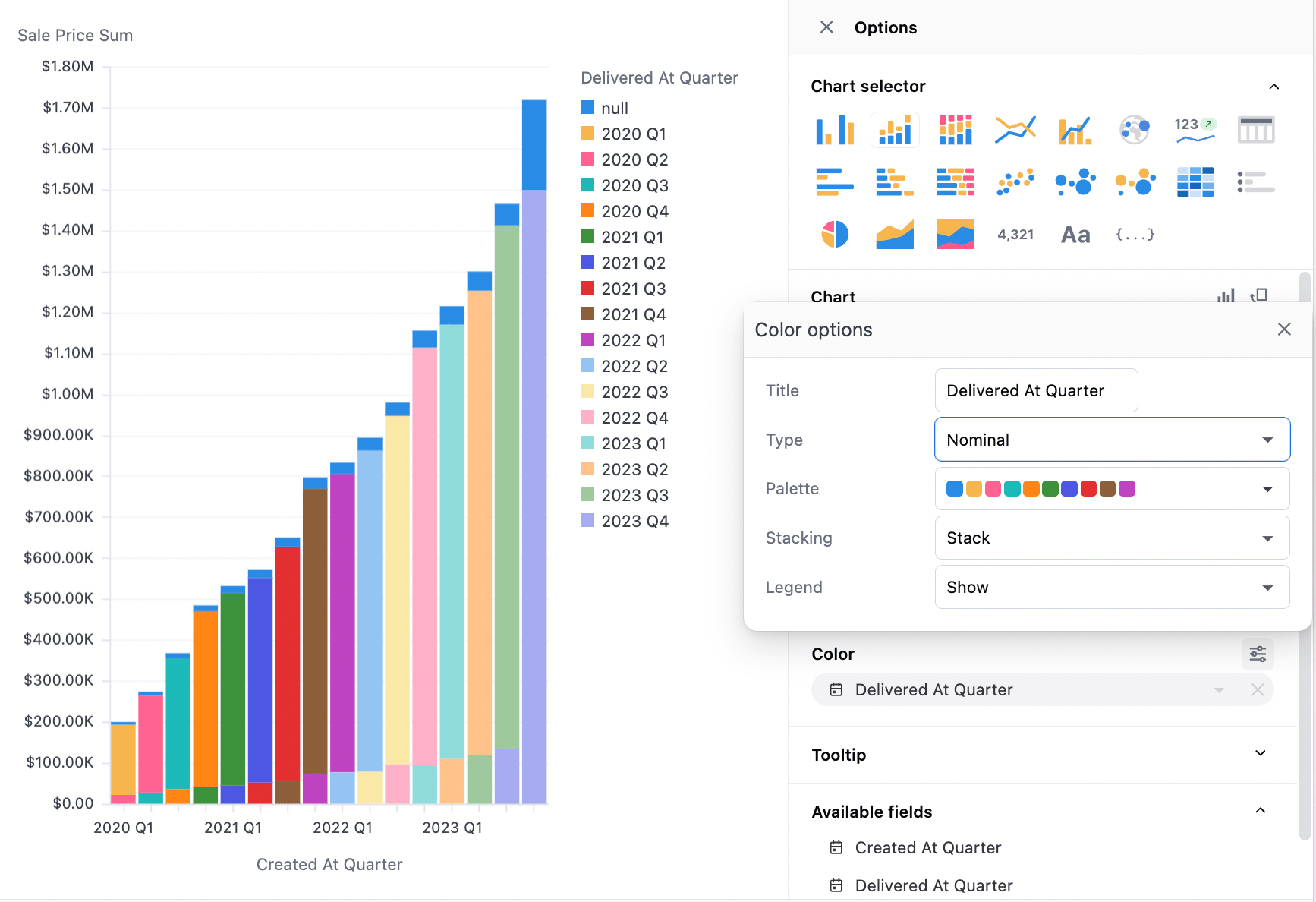
There will be slightly different options for string, date, and numeric data. Strings only offer discrete bucketing, while date and numeric data will offer both discrete (nominal) and continuous (temporal or quantitative) coloring. Note also that the palette options will change for discrete vs continuous, with discrete offering diverging color palettes and continuous offering a set of gradient color palettes.
When continuous options are not offered on an apparent date or numeric, casting the field may solve the problem.
String options
Numeric options
Date options
Palettes and color faceting
Section titled “Palettes and color faceting”When using color faceting, JustAsk automatically applies the organization’s default color palette to your chart, using the discrete or continuous palette appropriate to the data. In the case of discrete data, colors from the palette are automatically applied based on the sort order of the query and the color order in the palette.
For continuous data, the gradient palette is automatically applied to the range of the values from the query results. Select a different option from the palette menu to update the color treatment.
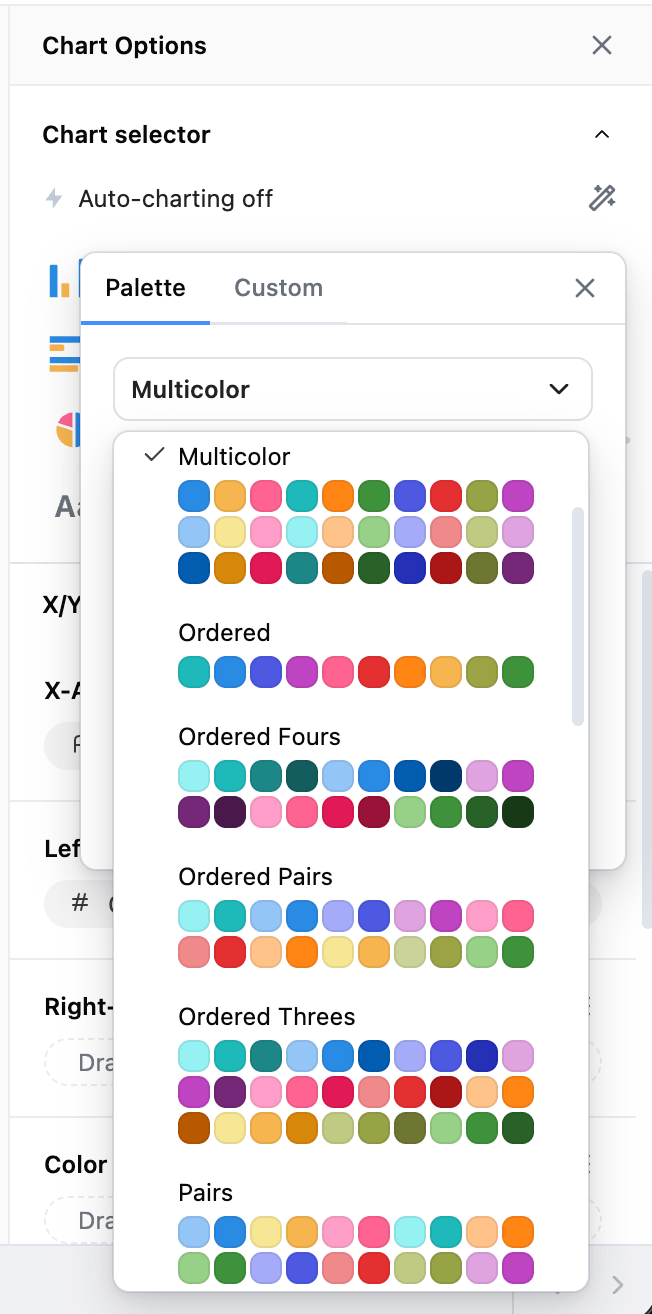
Use the Reverse colors option to reverse the order in which colors from the palette are applied to the data.
With color faceting, the series are not independently configurable. For independent color configuration of a given series, create separate measures for each series and refer to the section below on series color controls.
Custom palettes
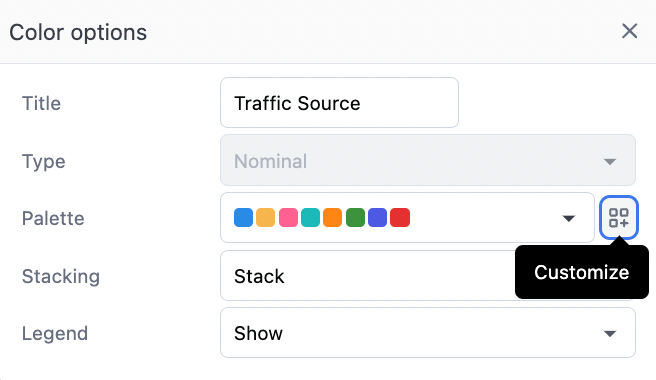
Section titled “Custom palettes”If one of the provided palettes doesn’t quite suit your visualization needs, a custom palette can be built for an individual chart. The last option in either the continuous or discrete palette menus is a Custom palette option. Select this option and then click the Customize button next to the menu. From here you can add, remove, and edit the palette colors:
Use the Open hex code editor button to toggle a bulk editor. This makes it easy to copy and paste a list of comma-separated hex values.
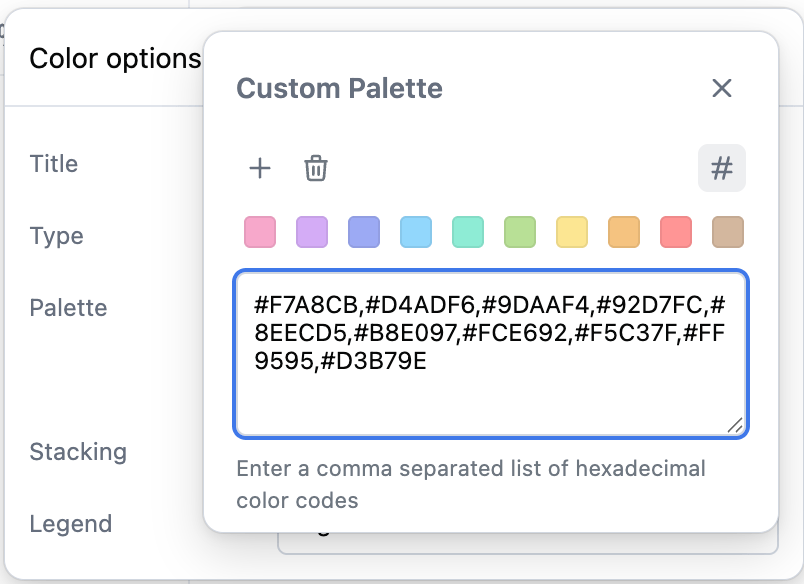
Custom palettes built for individual charts can be reused by copying and pasting the hex codes from chart to chart.
Series color controls
Section titled “Series color controls”Color controls are available on a series-by-series basis when no color facet is applied (with a single measure and no color, or with multiple measures). This will offer a simple color picker for each series.
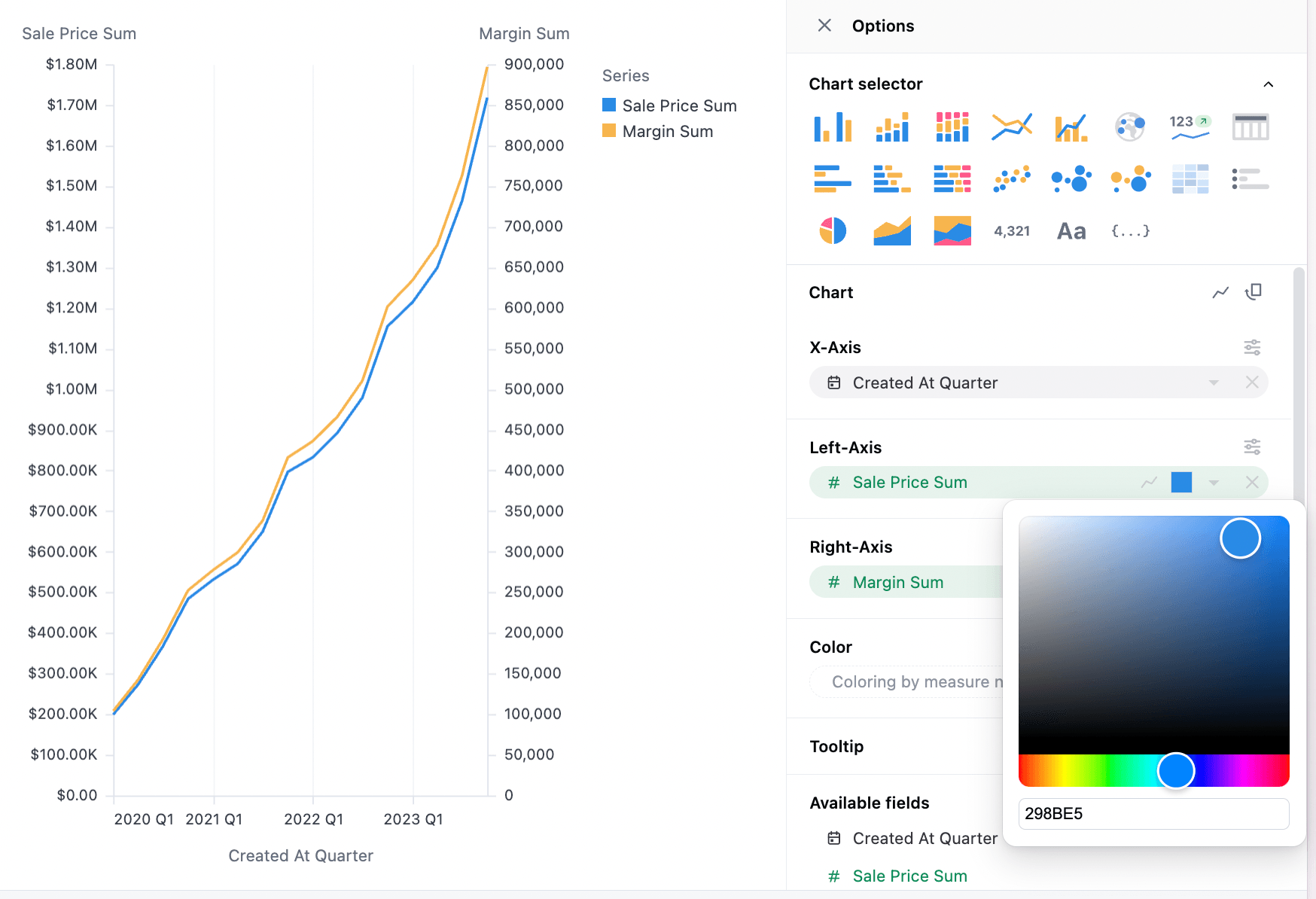
You can also map a color to a specific measure when using it as a series with the measure’s colors parameter (configured by your data team in the model).
Stacking options
Section titled “Stacking options”Several stacking options are supported:
- Automatic: JustAsk will attempt to select the best option from the four below
- Stack: The series will be stacked
- Group: The series will appear side-by-side (only offered for bar charts)
- Overlay: The series will appear on top of each other. This is how points and lines frequently work, but rarely valuable for bar.
- Stack %: The series will be stacked, and shown as the percentage rather than the absolute values. Note: The tooltip will show the raw value, not the percentage, so to add percentage it’s recommended to use table calculations like
% of row.
Stacked segment sorting
Section titled “Stacked segment sorting”When using stacking, you can control how the stacked segments are sorted using the Sort stack by option. The following sorting options are available:
- Label: Sorts segments alphabetically by dimension value. This is the default option.
- Value: Sorts segments by their measure value within each individual stack. This option is only available for bar and column charts.
- Sum: Sorts segments by their total sum across all stacks. This is useful when you want to see which segments contribute the most overall, regardless of their value in any individual stack.
- Unsorted: Preserves the original data order from your query results.
Legend options
Section titled “Legend options”Legends can be located on the right, left, top, or bottom of the chart. They can also be hidden.