Delivering JustAsk content via email
Creating an email delivery
Section titled “Creating an email delivery”1. Configure the delivery settings
Section titled “1. Configure the delivery settings”- Navigate to a published dashboard.
- Click File > Deliveries & Alerts. The delivery options will display on the left side of the page.
- Fill in the following:
- Delivery — Select Schedule or Alert.
- Send — Select the content to be delivered.
- Destination — Select Email.
- Name — Enter a name for the delivery.
If creating an alert, use the Alert tab to define the conditions that must be met to trigger the delivery.
2. Configure the delivery schedule
Section titled “2. Configure the delivery schedule”In this step, you’ll define the cadence for the delivery:
- For schedules, this determines when JustAsk will deliver the specified content to the destination
- For alerts, this tells JustAsk when to check if the current query results meet the conditions required to send the delivery
Schedules can be defined using the visual options or with cron:
Visual schedule builder
Use the UI options (Daily, Weekly, etc.) to select a time period.
By default, schedules are set to send in the local timezone of the delivery creator’s computer. Use the Times are in drop down to change the timezone.
Custom cron schedule (Advanced)
A cron expression is a string that describes the individual details of a schedule:
| Order | Unit | Allowed values | Allowed special characters |
|---|---|---|---|
| 1 | minute | 0-59 | * , - / |
| 2 | hour | 0-23 | * , - / |
| 3 | day of month | 1-31 | * , - / L W ? |
| 4 | month | 1-12 or JAN-DEC | * , - / |
| 5 | day of week | 1-7 or SUN-SAT | * , - / L W ? |
| 6 | year | any | * , - / |
Using cron, you can create schedules like the following:
0 9 ? * * *30 6 L * ? *45 8 ? * MON-FRI *JustAsk uses Amazon Web Services’ (AWS) syntax for cron expressions. Refer to the AWS documentation for more information. By default, the most frequent you can configure a schedule is hourly.
3. Select format and filter options
Section titled “3. Select format and filter options”In the Dashboard or Chart tab, you can:
- Select the format of the content, such as PNG, PDF, XLSX, or CSV
- Lightly customize the contents and layout, such as expanding tables to include up to 1,000 rows, hiding filter values, or arranging tiles in a single column.
- Set filter or control values for the delivery. Some formats will have additional customization options. PDF formats, for example, will allow you to specify the orientation and page size for the PDF.
For dashboard deliveries, the default filters and controls will automatically be applied upon creation. Subsequent default filter value updates will not change the filter values set for existing deliveries.
PNG deliveries
Section titled “PNG deliveries”If you select the PNG (image) format, how the image is included with the email will depend on the image’s size:
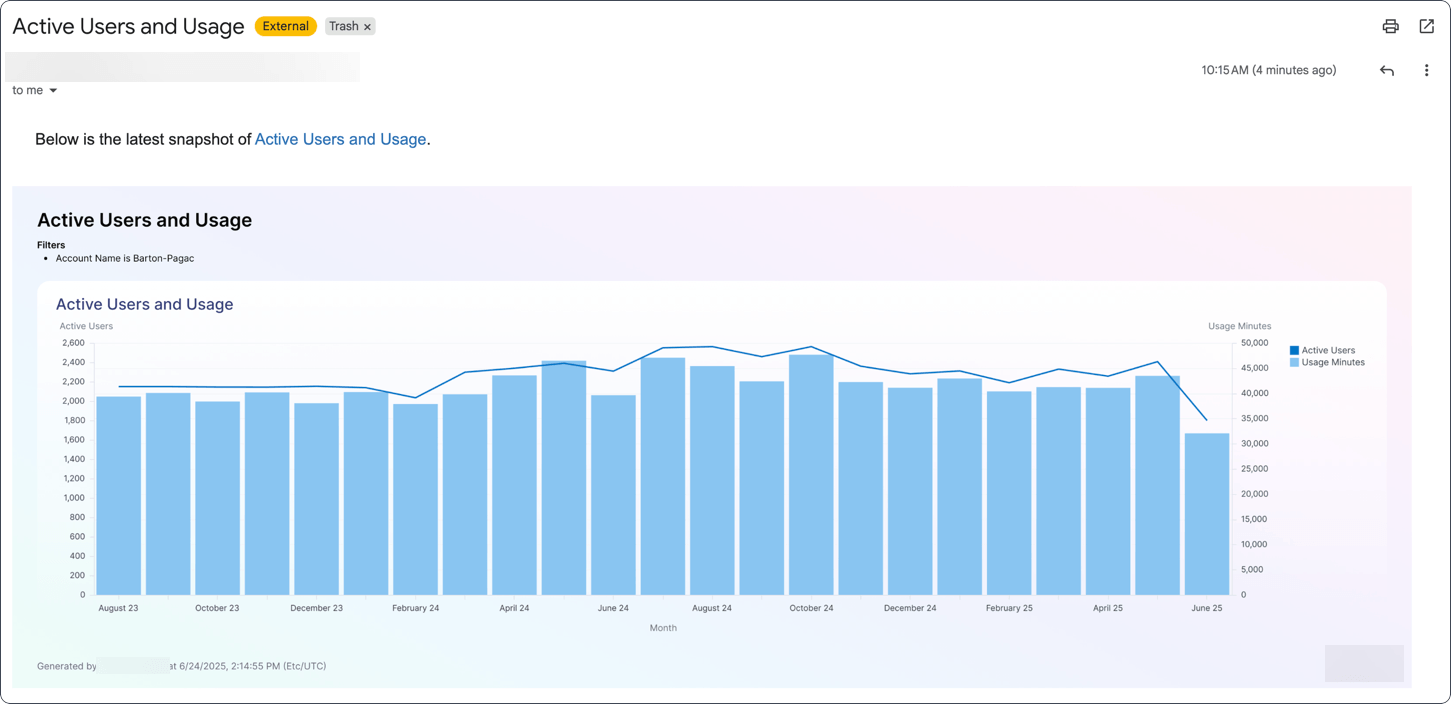
Deliveries 2MB or less
If 2MB or less, the image will be included inline in the email:
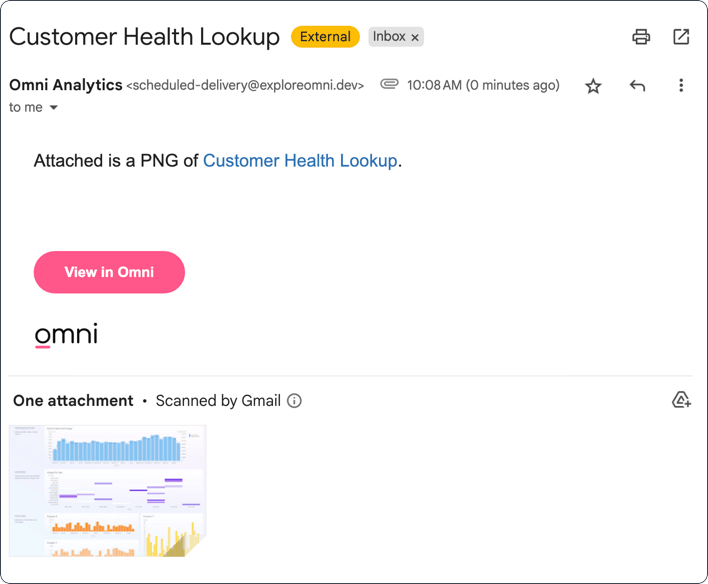
Deliveries larger than 2MB
If larger than 2MB, the image will be included as an attachment. JustAsk takes this approach to prevent failed deliveries, as some email providers limit how large inline images can be.
4. Configure email settings
Section titled “4. Configure email settings”To finish setting up the delivery, click the Email tab and fill in the following:
Recipients
Section titled “Recipients”Add one or more recipients. Recipients can be other members of your JustAsk organization or non-users, such as a contractor or external stakeholder. You can also add JustAsk user groups as recipients.
When adding recipients, note that:
- When existing JustAsk users are added as recipients there are no checks on whether or not each of those users have system access (connection or content permissions) to the content being scheduled. This means users could potentially receive content that they do not otherwise have access to in the JustAsk application.
- When non-users are added as recipients - that is, when a user with the recipient’s email can’t be matched to an JustAsk user - JustAsk creates an email-only user. These accounts are created when a delivery is saved to allow you to monitor scheduler usage and related metadata.
- If a user belongs to multiple user groups, they will only receive one delivery.
- If an embedded user adds their email as a recipient and a matching JustAsk user can’t be found, the user will be treated as the recipient. This includes their user attributes, which makes this useful when enabling Personalize delivery with recipient user attributes.
Personalize delivery with the recipient’s user attributes
Section titled “Personalize delivery with the recipient’s user attributes”If enabled, the content of the delivery will be personalized using the recipients’ user attributes. Otherwise, the delivery owner’s user attributes will be used.
For example, you could use personalization to deliver a dashboard to sales managers that only displays quarterly sales data for their region.
Subject and body
Section titled “Subject and body”Enter a subject and a body message for the email delivery.
5. Test the delivery
Section titled “5. Test the delivery”If you want to test the delivery before saving, click the Test Now button in the bottom left corner of the page. This will send the dashboard/chart to the destination using the current settings. For example, using Test Now would send the delivery to all Recipients.
6. Save the delivery
Section titled “6. Save the delivery”When finished, click Save to create the delivery.
Subscribing to email deliveries
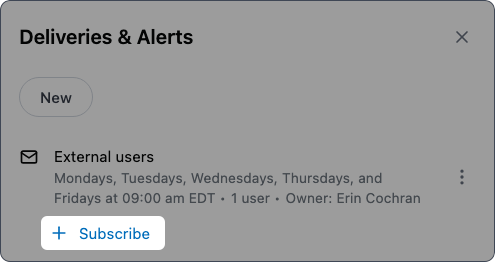
Section titled “Subscribing to email deliveries”If you aren’t currently a recipient of an email delivery, you can subscribe if you have the ability to view the schedule. In a published dashboard, navigate to File > Deliveries & Alerts and then click the Subscribe link under the schedule: